[Bologna, 1977] Semiologist Umberto Eco, professor at the University of Bologna, author of The Open Work and The Absent Structure, was one of the first intellectuals to comment in the press on the emarginati revolt movement. Eco is particularly committed to understanding the new culture of this movement of the unemployed, of students in the large cities. His analysis was taken up by both Christian Democracy and the Italian Communist Party, as well as by the fraction of the far left grouped around Workers’ Autonomy, the former reproaching him for not clearly condemning the Movement’s most violent forms of expression in trying to analyze them, while the “autonomi” reproach the exclusively semiological character of his analysis.
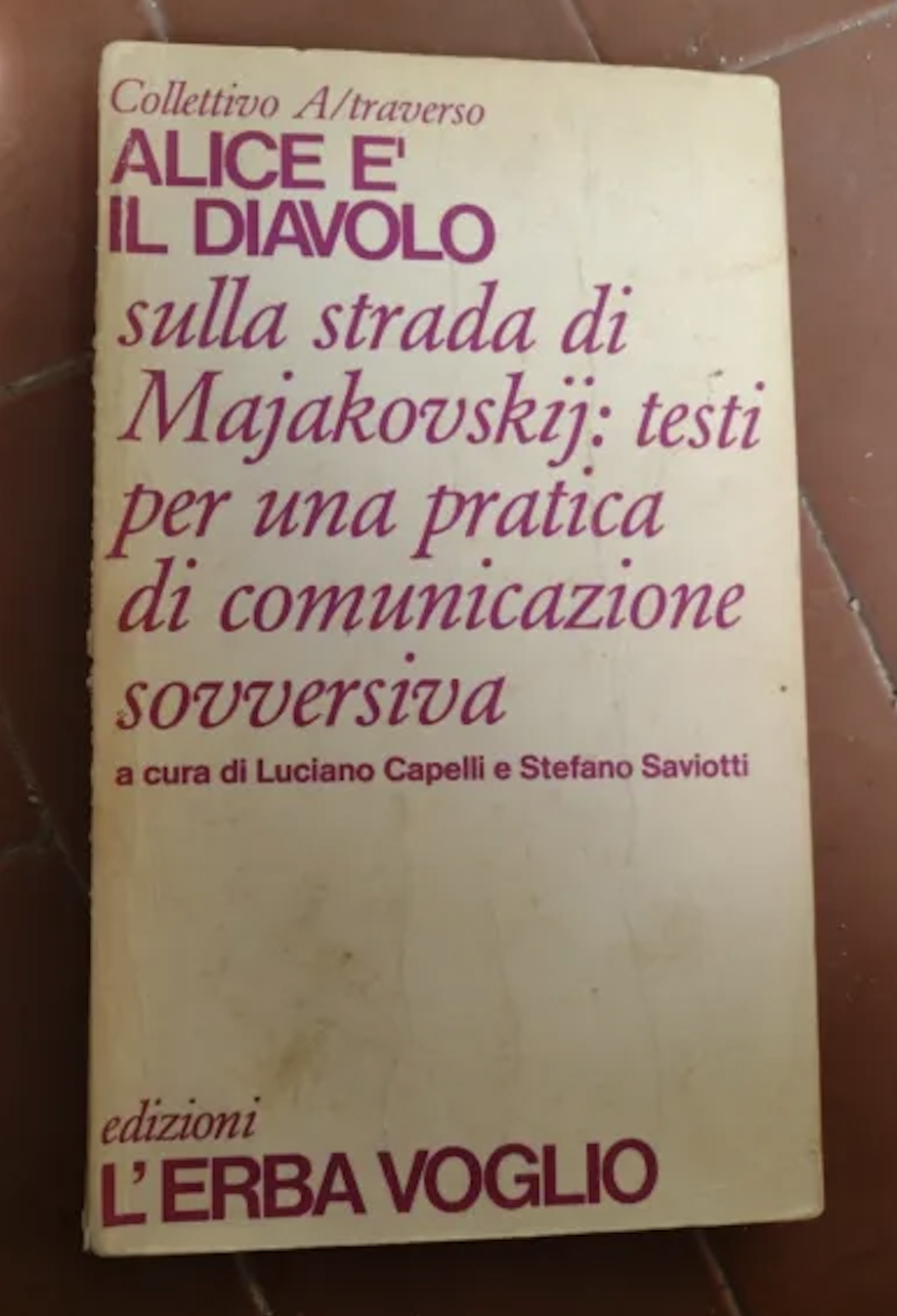 L’Erba Voglio editions have just published a book by the A/traverso collective, entitled Alice and the Devil – On the road to Mayakovsky: notes for a practice of subversive communication. [Alice è il diavolo – Sulla strada di Majakovski: testi per una pratica di communicazione sovversiva] Radio Alice is one of the many free radios that have sprung up in Bologna, and with the A/traverso collective forms one of the components of the Movement, this band of youth which constitutes, to use a very imprecise definition, “the territory of autonomy.” This book, it goes without saying, is of great interest at a time when, precisely, groups of this kind are discussed in connection with recent university events.
I know very well just how difficult it is to speak about these things, when Radio Alice is accused from all sides of causing disorder, as with episodes of automatic tariff reductions. [autoriduzione] But to accuse Radio Alice of being responsible for the anger of young people is like accusing the San Remo song festival of being the cause of national stupidity: it is to grant an almost magical power to the mass media. But the mass media, if they bring together, reflect, sometimes corroborate modes of behavior, if they reinforce opinions, they do not produce them. If there is a festival of San Remo, it is because there is a petty-bourgeoisie, sated with a false conscience, which understands nothing about music; likewise, Radio Alice exists because the anger of young people wants to give itself its own means of expression.
 But the paradoxical comparison stops at the music, and again, it’s not the same music! On Radio Alice you can listen to Jimi Hendrix, leftist singer-songwriters, Bob Dylan, the Beatles, the Rolling Stones, Frank Zappa and so on; at the festival, one hears Gigliola Cinquetti, Rita Pavone, Al Bano…). Behind (or in front of) Radio Alice are the parties in the piazza, the rediscovery of the body, the private, the proud assumption of deviance (of all differences, even those which are incompatible), the theme of the new youth proletariat, the demands of the marginalized. [emarginati]
Let us simplify, for the reader unfamiliar with these phenomena: behind Radio Alice, there are new “Indians” [the indiani metropolitani], many more than the leaders of 68. You have to know this, because if you read this book as any document, without linking it to the current situation in Italy, you would run the risk of not seeing all those seasonally unemployed, those hippies hanging out in train station waiting rooms, those naked bodies looking for a new contact. We would only see a new cultural group – one more! – talking about these things with new means and a new style of expression.
“Radio Alice offers you music, information, flower gardens, enormous remarks, inventions, discoveries, recipes, horoscopes, potions, stories of love, press releases of battles, photos, messages, massages, lies…” They comment on their favorite films: Yellow Submarine and Lassie Come Home; they amuse themself by setting up the most advanced dissonances with The Blue Danube; they quote Eliot (“April is the cruelest month”) in connection with a strike; they propose to invent “a minor becoming” and “to reason, not by metaphors, but by metamorphoses”; they evoke Lautreamont, Artaud, de Sade, and Mandrake… The preface of the book opens with the famous quotation: “Hypocrite lecteur, etc.” but it’s no longer Baudelaire, it’s Nabokov, who quotes Eliot, who quotes Baudelaire.
 Such a reading would be imprudent, because, as I said, behind books and radio, there is a very real youth, who use books and radio as means of expression. But it is hard to resist the temptation to see in Radio Alice the last offshoot of the line of avant-gardes, the one who discovers new means of expression to achieve what is no longer found, at least at such a creative level, nor in collections of poetry or in experimental novels.
If we had to stop there, we would have said it all by saying that Radio Alice brings together a few people of very sophisticated culture, using, for their own needs of expression, the reality of marginalized young people, like Balestrini, in his novels, uses the recordings of workers’ struggles. (With this difference, however, that Radio Alice is able to make the marginalized speak, even in the first person, as authors of programs or protagonists of educational events.) But this would be an unfair way of saying that it is just a handful of aesthetes who exploit a wider and more worrying social reality for expressive purposes.
The fact is that Radio Alice elaborates alongside this, and through this, ideological proposals for the new revolt of young people. I am unable to say whether it ‘produces’ them or whether it is content to ‘reflect’ them, so complex is this situation; so as not to abuse expressions such as movement, autonomy, 1968, I would simply say that it is a question of a generation which, as soon as it appeared, wiped the slate clean of everything that was said before (and during) 1968: seventy-seven minus sixty-eight is nine; I will therefore speak of the generation of Year Nine.
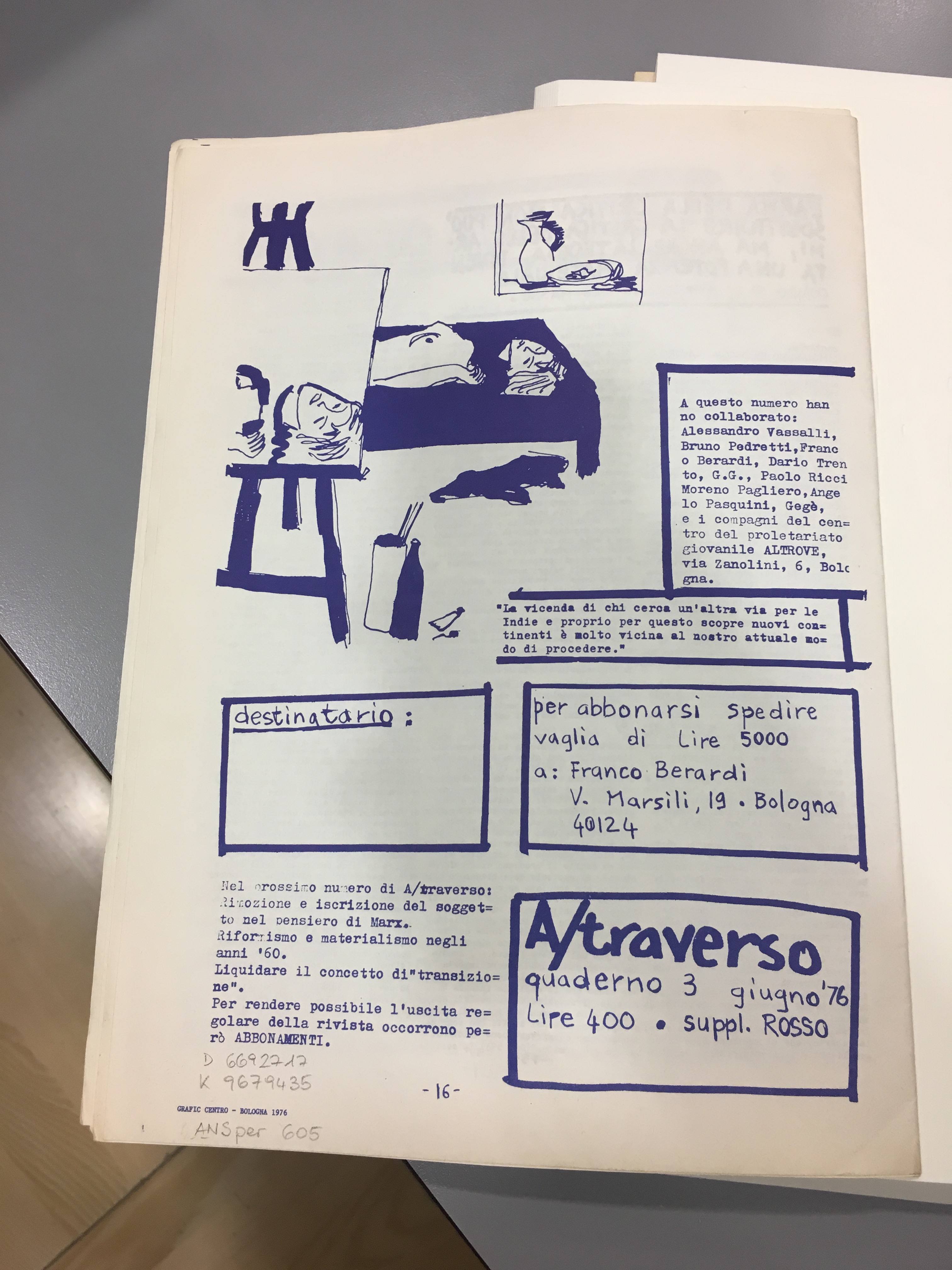
The philosophy of Year Nine, expressed by the A/traverso collective, affirms that “desire, today, has spoken”; against the desires of the power to “criminalize” the creative act and the liberating relationship, this generation wants to practice a “transverse” writing, which circulates, produces, transforms and “liberates desire.” We naturally take the word “writing” in a very broad sense, one writes just as well with the radio, with the whole body, one writes to give an expression in a way to the “revolutionary desire of young proletarians, absentee workers, cultural and sexual minorities.” This writing, inevitably, has a protagonist, the “small group”, which reintroduces, in contradiction with the principles of the collective, the notion of avant-garde as a reference; but this small group gives rise to the formation of other small groups (this proliferation of “group heads” makes any definition of the Movement impossible).
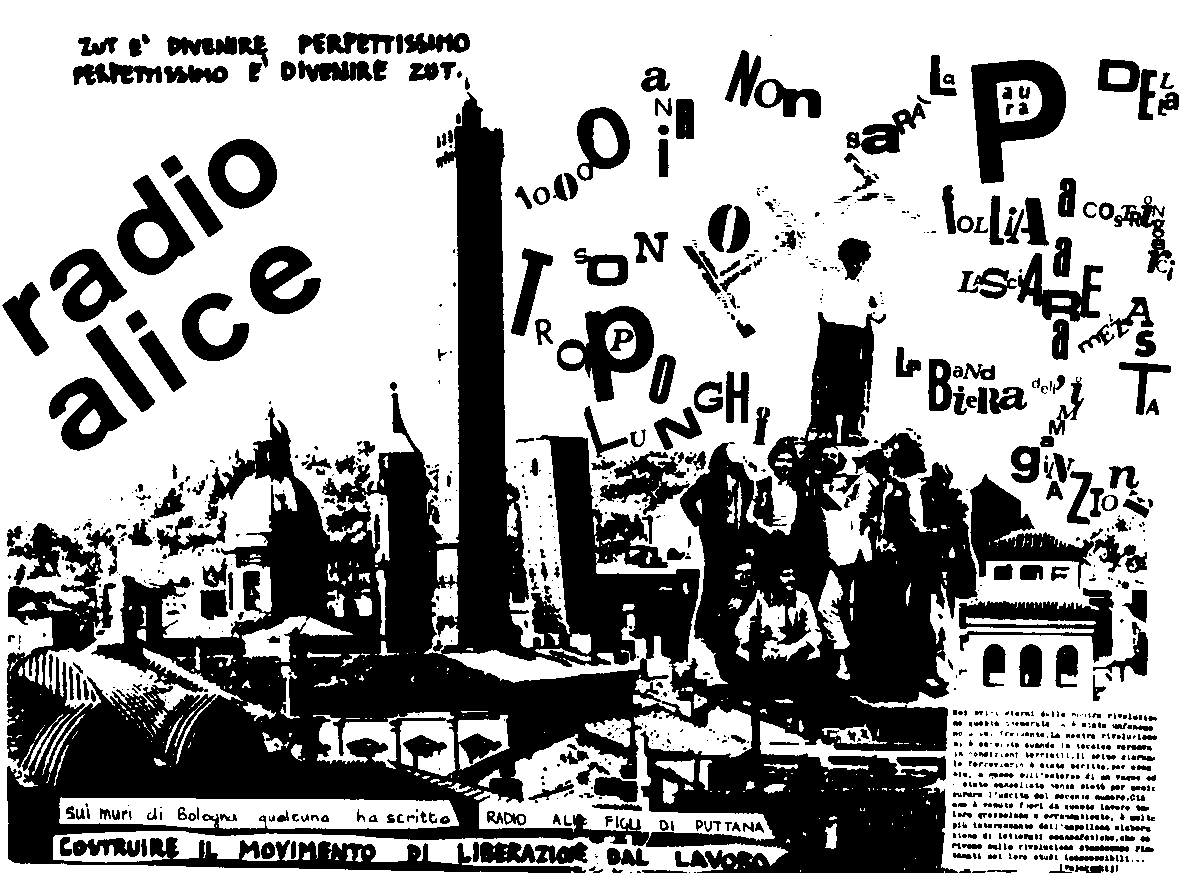 Liberating desire means refusing the shackles of reason, meaning, morality and politics, to find “the irrational under everyone’s shell.” The irruption of subversive desire upsets accepted codes, language ceases to be a neutral instrument to become a permanent subversive practice; it breaks down the constraints of meaning, the only means of then overthrowing the dictatorship of politics. Through collective writing, through the circulation of new texts, “through wild transmission,” life is painted red; this is what Mayakovsky already wanted. This “Mao-dadaist” writing reverses the relationship between art and life: “Life becomes the work of art; the authentic work of art is the infinite goal of man who moves harmoniously among the incredible mutations of his particular existence.
 These assertions – which the space of an article inevitably reduces to a collage, which is worth what it is worth – call for a few observations. First, we are in the presence of a form of aesthetic vitalism, which presents curious analogies with futurism and other Italian currents of the beginning of the century, even in the indirect reference to Nietzsche; it is then astonishing to see the theoreticians of the marginal proletariat handle the most cultivated language, the most refined of all, the one with the best pedigree; comparisons therefore come immediately: it’s the new Marinetti, it’s the new team of the journal Lacerba, it’s the reissue of the Uomo finito and [Giovanni] Papini’s Super-Man. But, unlike the avant-garde at the beginning of the century, these groups are really in contact with a “base”, that of Year Nine, and what they say seems instinctively accessible, in all its vitality, even to the uneducated; a sign therefore that theory can be translated into concrete gestures or that the collective gesture inspires theory. This relationship, of course, is not without ambiguity or danger, but we cannot judge it on criteria analyze other phenomena: it needs to be completely re-studied.
Those who have, for example, a certain familiarity with French post-structuralist thought, will discover through a series of testimonial quotations the direct source of this discourse: Deleuze and Guattari’s Anti-Oedipus, with its background of psychoanalysis reviewed through a transversal reading of Marx, Freud and Nietzsche, plus antipsychiatry, plus the crisis of May 68, plus the withdrawal (in Paris, but not in Italy) of this thought on purely theoretical positions, without more contact with mass political practice.
 The interest and the novelty of Anti-Oedipus (published last year in Italian by Einaudi) lies in the assertion that the unconscious is not a structured building, as classical psychoanalysis would have it, but the place of the permanent production of desire, a place associations, destructurings, aggregations, production of “desiring machines”; the assertion, always, that human history is traversed by this schizophrenic process (not to be confused with schizophrenia), stifled up to now by the large “paranoid” structures which do everything to bend to an order, to a law, the flow of desire, We will better understand, from there, the new opposition: that which this generation of Year Nine draws between itself and those which it rejects as a whole in the paranoid: the ex-young people of 68, the PCI, and the entire repressive state apparatus.
We can think what we want of this opposition. Personally I think that it is only a metaphor, instituting no victorious hierarchy. And historically I belong to the paranoid generation. But I make my conditioning clear.
One thing is clear, however: the opposition was not “invented” by the authors of Anti-Oedipus, any more than the anger of young people was fomented by Radio Alice. Both theorizations (the former very rich and academically complex, the latter more ‘student-like’ and aphoristic) are driven by the facts (and, if anything, Deleuze and Gauttari were prophets and those of Radio Alice are the Christian apologists). But if one will have the courage to analyze the new ideology of desire, to determine the nature of the social phenomena that it sublimates, it must not be liquidated with facile slogans. For their part, the A/traverso collective, if it reflects, will have to admit that its wild practice has academic sources. [matrici accademiche] Otherwise, we will be entitled to return, slightly retouched, and to the fourth power (reread “a/traverso”), the poet’s invective: “you, hypocrite writer, my fellow, my brother!”
Subversive Communication Nine Years After 68 (or, Year Nine)
Translated by Joseph Sannicandro
Sources:
U. Eco, “La comunicazione sovversiva nove anni dopo il sessantotto.” Corriere della sera, 25 February 1977. [Italian]
U. Eco, “Anno Nove,” in Sette anni desiderio: cronache 1977-1983. Milano: Bompiani, 1983. 59-63. [Italian]
U. Eco, “La Communication Subversive Neuf Ans Apres 68.” Italie 77. Le «mouvement », Les Intellectuels. Documents rassembles par Fabrizio Calvi. Traduits par Evelyne Grande, Mario Fusco, et Alberto Della Penna. Paris: Editions Du Seuil, 1977. [French]


