Lino Capra Vaccina is one of the greats of Italian minimalism. In the early 1970s he was a founding member of the ethno-jazz group Aktuala, who pioneered a distinctly Mediterranean form of contemporary music more than a decade before industry suits coined the term “World Music.” After his departure, he joined Franco Battiato (with whom he would continue to work with throughout the 1980s) and other luminaries to form the short lived supergroup Telaio Magnetico for a 1975 tour of the south of Italy in support of the legalization of cannabis. His magnum opus, Antico Adagio, meaning “ancient adage,” was released in 1978, and remains one of the high water marks of Italian minimalism. Re-released on CD in the 1990s, it found wider acclaim with an international audience after being reissued on vinyl by the venerable Die Schachtel label in 2017. Since then, Vaccina has released several new works for Dark Companion, including Arcaico Armonico (2015) and most notably Metafisiche Del Suono (2017). He joined Area’s Paolo Tofani and Keith & Julie Tippett for 2019’s A Mid Autumn’s Night Dream, and has also joined Toni Cutrone’s Mai Mai Mai for several collaborative performances, following appearances on Phi (2016) and Rimorso (2022).

I met maestro Vaccina at the Jazz is Dead festival in Torino, on 24 May 2019, where we spoke briefly about his concert and recent collaborations with Paolo Tofani (of the great Milanese band Area). We had previously been in touch via email, where we have carried out a gradual email correspondence in Italian. I was interested in asking him about his works from the 1970s as part of research contributing to my doctoral dissertation. Now that that’s behind me, I’d like to share that interview with paid subscribers here via Substack, and will make sharing such archival interviews a regular feature. What follows after the paywall is some additional context from me, and a version of our correspondence, translated and lightly edited for clarity.
Formed in Milano in 1972 by percussionist Lino Capra Vaccina and the multi-instrumental Walter Maioli, Aktuala released three critically-acclaimed albums on the Bla Bla label between 1973 and their dissolution in 1976. Taking their name from the Esperanto word for “Current” (as in, attuale in Italian, or actuelle in French), this gestures towards a utopian universalism also manifested in the hybridity of their music. The word Esperanto itself means “one who hopes,” encapsulating the utopian desires which proliferated during those years. Their sound has been compared to contemporaries such as Oregon (a US based jazz group on ECM), Third Ear Band (a UK group who combined ragas and European folk with medieval influences and an experimental edge), and especially Embryo (a German psychedelic jazz rock group with collaborators from North Africa, India, China).
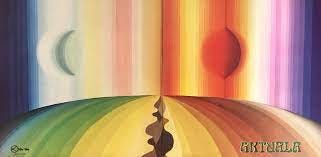
Aktuala combined elements of ancient (Mediterranean) and ethnic musics (Turkish, Arab, African) with rock, jazz, and avant-garde influences, creating a pioneering new form of music that has proven to be an important influence on subsequent generations of Italian (and international) musicians. Utilizing elements of composed and improvised music, as a group they resist the veneration of the ‘genius’ that defines the public relationship with the cantautore (singer-songwriter, and/or lyricist) typical of Italian popular song-craft.
In 1975, Vaccina joined forces with Franco Battiato, one of Italy’s top prog artists then in the midst of his most experimental phase, who in a few short years would go on to become one of Italy’s most famous musical artists. Vaccina explains that, “with Franco and I, and Juri [Camisasca] at times, there was talk that it would be nice to make a group, with which to make a totally avant-garde / experimental music.” This talk eventually led to inviting other musicians to form the “super group” Telaio Magnetico [Magnetic Frame]: Roberto Mazza, Mino Di Martino (formerly of the beat group I Giganti) and his wife Terra Di Benedetto, who would shortly form the more psychedelic Albergo Intergalattico Spaziale). This formation lasted only for a short tour of the south of Italy sponsored by the Radical Party [Partito Radicale] in support of the legalization of cannabis (and prevention of the use of hard drugs), but the experience would influence the direction the various members music would take subsequently. In 1975 the Radical Party was “a relatively new political force focusing on civil libertarian issues,” exploiting a gap left by the social conservatism of both the Christian Democrats and the Communists. This association with the Radicals (and cannabis) influenced the form that their richly textured and free form music would take.
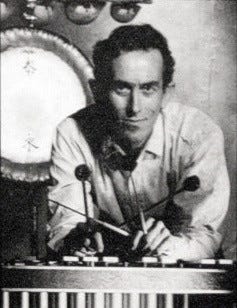 Battiato performed on an EMS VCS3 synthesizer, an instrument he had introduced to Italian audiences on his earlier records, likely the first use of synthesizers in Italian popular music. [Richard Teitelbaum of Musica Elettronica Viva had brought a Moog synthesizer to Italy in the late 1960s, but MEV’s music was far from pop.] These textures were augmented by Di Martino’s Farfisa electric organ, combining to form dense pulsating drones grounded by the gentle rhythms and textures of Vaccina’s vibraphone, gong, and cymbals. Mazza improvised restless melodies with his various saxophones or oboe, while Terra Di Benedetto and Camisasca’s vocal interplay, utilizing delay effects and vocal drones, grants the project its most psychedelic qualities. Martin Heidegger argued that the essence of technology was Gestell, an enframing or positionality, which is to say that technology provides the framework by which we understand our world. And, for Heidegger, the danger is that everything in that world may become reduced to a “standing-reserve,” waiting to be used or organized. The name Telaio Magnetico is apt in so far as their use of electronics provides the sole constraint which frames their musical interplay.
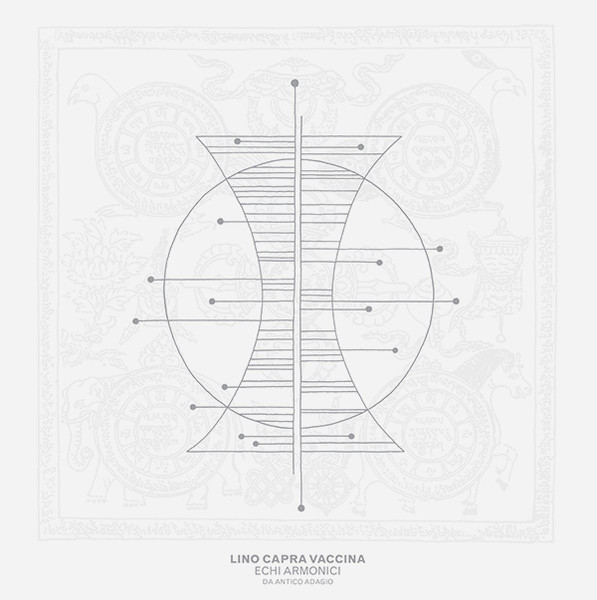
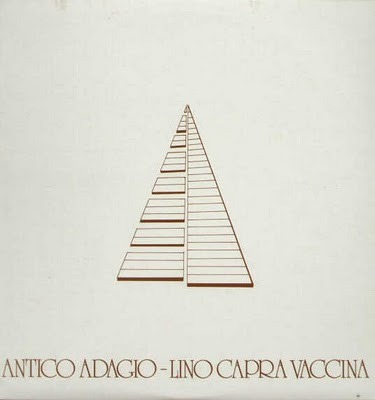 Vaccina would go on to compose and record Antico Adagio, a record which remains one of the highlights of so-called Italian Minimalism. Released on the Nō label in 1978, enough of a success at the time to command a repress in 1979. Musicando granted the work a CD edition in 1995, which would be repressed on vinyl by Die Schachtel in 2017, alongside additional material composed and recorded in the same sessions: Frammenti Da Antico Adagio (2014) and Echi Armonici Da Antico Adagio (2017). As a studio composition which he’d begun to workshop at the 1976 Re Nudo festival, Vaccina could deploy a much wider array of instrumentation than was practical as a touring musician, let alone one performing in the town square, as Aktuala had done: vibraphone, marimba, tabla, wooden drums, darbuka, cymbals, gongs and metal sheets, various bells, bass drums, tom toms, and even a sprinkling of piano and voice. Additionally, he recruited contributions from Mario Garuti on violin, along with Telaio Magnetico members Roberto Mazza on oboe and Juri Camisasca on vocals.
Vaccina describes Antico Adagio as a “mystical embrace,” one born out of “the search for a sonorous spirituality.” He locates the genesis of this spiritual sensibility in his encounter with various non-Western musical traditions.
In the past I studied and listened to a lot of traditional / ritual / spiritual music from central and northern Africa, from southern and northern India, from Japan, in particular the music of the Buddhist monasteries, of the NO theater.
He began to consider the act of producing sound as a ritual practice, one tied to natural elements and a relationship to the ancestral, hence the “ancient adage” of the title. With Antico Adagio, Vaccina worked to make a composition that was not derivative nor even contained explicit references to any of these traditions, but which could nonetheless evoke a feeling of inner quiet and joy. This was very much in contrast to the intensification of social struggle of the late 1970s. Vaccina had come to find the political ideologies of those years to be too “hard and inflexible,” and as an adherent of non-violence he found he could not relate to the increasingly violent expression of political struggle. The mystical pursuit of Antico Adagio thus marked the beginning of a new area of sonic research which has continued to guide his practice ever since.
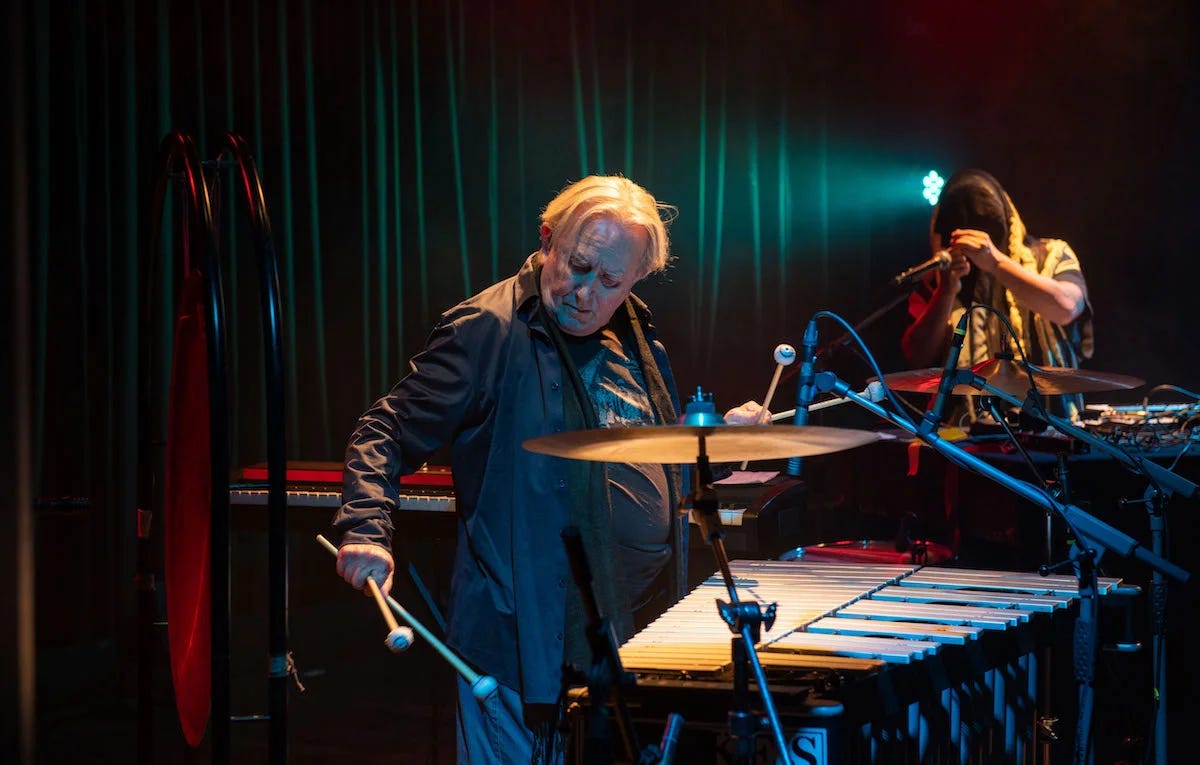
INTERVIEW
Joseph Sannicandro: Tell me about your origins as a musician. Where did you grow up? When did you first study music?
Lino Capra Vaccina: Regarding my origins as a musician, I started very young, at 15/16 I founded a group with some friends, and after preparing a series of songs, we looked to play in some clubs, then I founded another one, ( more daring and experimental) with whom we managed to play around, and so I began my first experiences as a musician, at the same time I played in a group of adults who played in important clubs, clubs in Milan.
I grew up in Milan, and started studying music as self-taught at 11/12 years, then at fifteen I studied theory and percussion from a private Maestro, a friend of my Father, and after a few months of lessons, he took me with him to play (as I said before), after I studied in addition to Percussion, Piano, Composition, History of Music, at the Civic School of Music in Milan.
In this period, did you make a distinction between composing music and playing music? What I mean is … There is the act of writing / creating music, per se. And then there’s the show, it’s the act of playing for an audience (even if only yourself). For you, was there a distinction between these musical aspects? And then, in the recording studio, is the act of recording a different art, in which to produce a work of art distinct from a solo composition?
Yes, I think I understand what you mean, interesting, I will try to answer. For me these three moments have always been composing, playing in public, recording a record, it is important that they have something that unites them, that connects them to each other, a bridge so to speak, which allows me to go through them with a common thread. The Music, the sound, with their expression, using them as a central point of reference to pass from one musical work procedure to another. This operative procedure, I have tried to develop and apply it, since the beginning of my artistic career, in fact this modus operandi. I already used it in the times of Aktuala, then I continued to use it always, developing it through continuous research. And in recent years I have created a real technique of this procedure, which I use and apply both when I record a record, and also when I play in concert. This technique consists in composing and reassembling the pieces live, in free form, that is, I compose while I record (naturally, first the piece is thought and written, giving it a shape, a structure, harmonic, rhythmic, melodic, timbral, etc.), then when recording or performing in concert, I use this technique of live recomposition (while playing directly) in free form of the pieces. I repeat this because, in my opinion it is important that those three moments Composition, recording and performance in concert, have a sonic affinity of thought, expression, intention of musical conception, empathic and unique, leaving room for the possibility of manifesting something else … in making Music.
Aktuala performed in public spaces often, is that right? What was the thinking behind this? How did the unsuspecting public react? Did fans come to see you in these situations, those who knew you and your music, or did you intentionally play to those who were unfamiliar with your music?
Yes, we often played in public spaces, we had the idea of doing it because our instruments were all acoustic, we could play even without amplification, and therefore everywhere, in any kind of space, what we did, then we liked the idea to involve the public in a total way to participate in our executions / performances, it was a way to feel together, to participate collectively in a communal way, at that time, the public liked very much, to feel part of it, we were the first in Italy, to do this kind of happening, perhaps even in Europe. The fans came to see me in these situations and those who knew Aktuala and my music, but it didn’t matter.
What about the festivals of those years? Re Nudo, and the like, how were the festivals that Aktuala played in?
The great festivals of those years were a total anarchy of organization, participation, only the desire to be free, to be together, to want to listen to music, to discover, to know and love each other, this and much more. Aktuala played at the second Re Nudo, outside of Milan. In the mountains, to the Re Nudo of Parco Lambro no, I played as LCV to that of 76, with the origins of the music that would later become those of Antico Adagio.
You have known Walter [Maioli] since you were boys. Can you please discuss the origin of Aktuala? You both were very young when that first record was recorded, and while there is no doubt a youthful energy it also strikes me as very sophisticated and worldly. Italian music, it seems to me, very much privileges lyrics, and the cantautore, or the singular composer. Aktuala was explicitly collective and a collaboration. You even lived collectively for a time, is that right? Can you tell me more about this, practically speaking (how did it work?), musically (what did it allow for?)
Aktuala began as a group, founded by me and Walter Maioli, then after I left the group, it becomes a sort of collective, which from time to time participate in collaborations. In the beginning we went to live together, for as long as I remained in the group, and it worked very well, musically allowing to have a great interpretation, executive, thought and intent, which were very important for the musical language of the group, in the first two records, then I think all this was lost .
Although you left Aktuala, you performed with Walter again in Telaio Magnetico. What a line up! How did this come about? Was Battiato the organizing principle, as the current music press seems to assume, or was it as collaborative and collective as it sounds? How did the relationship with Partito Radicale come about?
The T.M. was born in a rather casual way, with Franco and I, and Juri at times, there was talk that it would be nice to make a group, with which to make a totally avant-garde / experimental music, and so it was, we talked about it with other musician friends, and the group was born. At that time Franco and all of us in the group performed a few concerts individually with P. Radicale, who organized concerts to propagandize the Party, Franco told him about the group, and they organized a short tour of us in some cities of central and southern Italy.
Regarding your masterpiece Antico Adagio, this LP feels like an embrace of the mystical. Was it a reaction to the inflexible ideologies and politics of the 1970s? Against matches, armed struggle, violence, etc? How did you relate to politics? To the mystical aspects of sound? What was the origin of Antico Adagio?
Antico Adagio, as you say well, is a mystical embrace, in fact it was born with this intent and the search for a Sonorous Spirituality. In the past I studied and listened to a lot of traditional / ritual / spiritual music from central and northern Africa, from southern and northern India , from Japan, in particular the music of the Buddhist monasteries, of the NO theater. In all these music the common thread is to make music for the elements of nature, for the sky, the sea, the river, the stars, etc., making music for something Ancestral. In the ritual of making music, the central point is acoustic, it’s sound.
Starting from this premise, I started thinking about the music of A.A. which is mainly born with the desire to make my own music with an original, unique and innovative language, which does not have in itself references or is derivative, and contains and transmits, both when you play and when you listen to it, a sense of concentration, inner quiet, expanding the perception of feeling, to another, as my listeners often tell me, to make you feel good.
No, it was not a reaction to the politics or ideologies of those years, which were certainly hard and inflexible. I am against violence and armed struggle, I do not like violence. I did not relate to politics, too much, when I was adolescent, I sympathized with those forms of adhesion (which are typical of that age) such as Anarchy, but basically I have never related to it.
Antico Adagio was a true beginning of a new artistic, compositional, musical, fundamental, fixed point and very important for my artistic career, that sound research, which over time I have carried out and developed in other works, up to now, which has allowed me and allows me to raise the bar higher and forward, in the works that I compose.
Infinite thanks to the maestro, Lino Capra Vaccina.
 Sound Propositions
Leave a comment